Solutions · Planning Guide 04
Warewashing & the dishroom.
The dishroom is a workflow, not a machine: scrap, wash, dry, store, transport. Getting it right pays every single shift — in labor, in water and energy, and in ware that survives.
A workflow, not a machine.
Dish machines get specified in an afternoon and regretted for a decade. The questions below are the ones that separate a dishroom that keeps up from one the whole kitchen waits on.
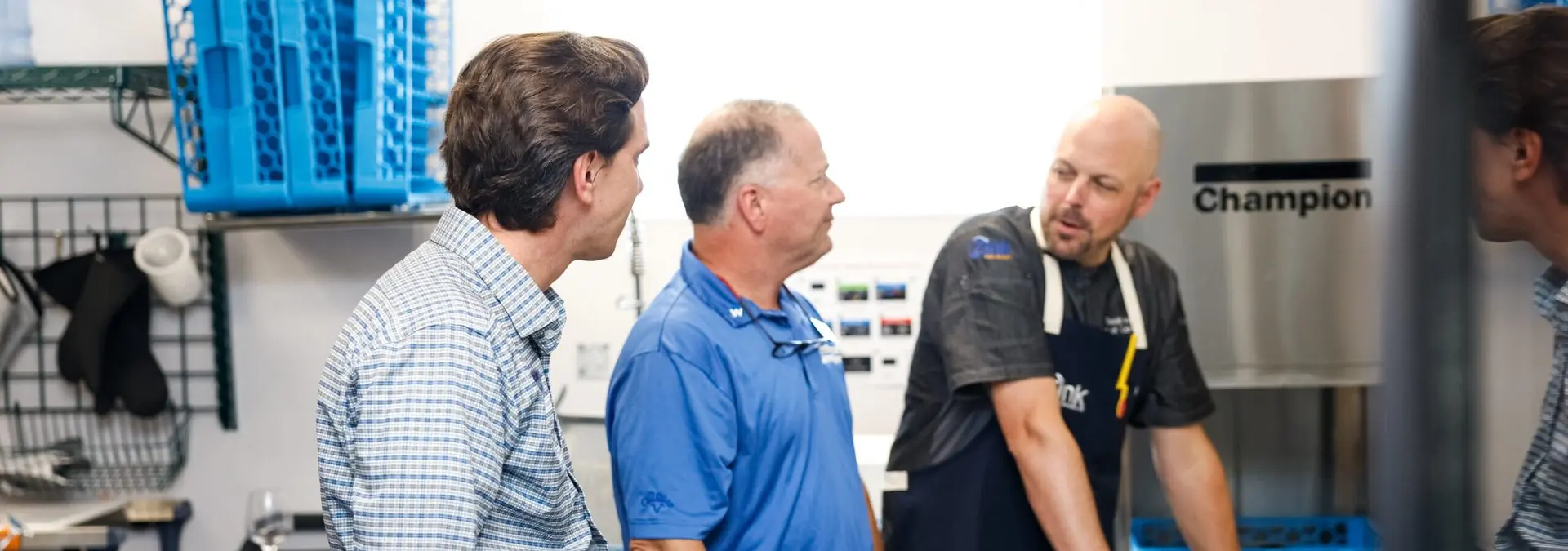
High-temp or low-temp: the fork in the road.
High-temp machines sanitize with hot water; low-temp machines sanitize chemically at lower temperatures. They differ in utility demands, chemical costs, and what your building has to support — both keep you compliant when run correctly. Which one wins depends on your volume, your ware, and your utilities.
Match the machine to the rush, not the average.
The ladder runs undercounter, door-type, rack conveyor, and beyond — and the right rung is set by your busiest hour, not your daily average. A machine that keeps up at 7 p.m. on Saturday is the spec; everything else is a compromise you'll staff your way out of.
Labor is the biggest line item in the dishroom.
Layouts that cut touches, machines that cut rewash, and pre-rinse stations that don't fight the operator all show up as hours saved — every shift. When we spec a dishroom we walk the path a bus tub actually travels, not just the machine's footprint.
Ventless options when the building says no.
Some machines are engineered to run without a dedicated exhaust hood — a retrofit-friendly path when adding ventilation is impractical or the space can't support it. If you're renovating, ask this question before drawing the room.
The machine is half the spec.
Racks matched to your machine and your ware, drying and storage that keep clean ware clean, and transport that survives a wet, corrosive room — the equipment around the machine decides whether your china and glassware make it to year five. Protecting that investment is the quiet payback of a well-specified dishroom.
Warewashing & storage lines in the portfolio
Every line links to its page — coverage, categories, and the Zink team behind it. Or filter the whole portfolio by your state in the Product Portfolio.
Common questions.
Should we choose a high-temp or low-temp dish machine?
It's the first fork in the road: high-temp sanitizes with heat, low-temp sanitizes chemically. Utilities, volume, and labor decide which fits — our dish-machine selector walks the same questions our specialists ask.
What size dish machine do we need?
Match the machine to the rush, not the average. A machine sized for your busiest hour keeps the dishroom from becoming the bottleneck that backs up the whole line.
Is there a dish machine option for buildings without a hood?
Yes — ventless warewashing exists for spaces that can't duct to the outside. Tell us what the building allows and we'll show you what fits it.
Bring your busiest hour. We'll spec around it.
Rack counts, layouts, and machines matched to how your operation actually runs — worked out with your dealer, at no cost to you.
Keep exploring